
Teterboro Medical Transport — The Ground Legs of a Private Medical Flight
When a patient flies into or out of Teterboro (TEB) on an air ambulance, a medevac fixed-wing, or a family's chartered jet, the flight only covers the middle of the journey. Delta Medical Transportation runs the New Jersey ground legs — a local, licensed BLS crew handling the bedside-to-wing and wing-to-bedside legs, coordinated to your wheels-down time.
The Flight Quote Ends at the Airport. The Patient's Trip Doesn't.
Every private medical flight has three parts, and the aircraft only covers one of them. Someone has to move the patient from a hospital bed, a rehab room, or a home in New Jersey to the aircraft — and on the other end of the country, someone else has to do the same thing in reverse. In the air-medical industry these are simply called the ground legs, and here is the part most families discover late: the flight company usually doesn't run them. Air-ambulance carriers and jet charter brokers subcontract the ground legs to whatever local company answers the phone, often sight-unseen, sometimes booked from a call center three time zones away.
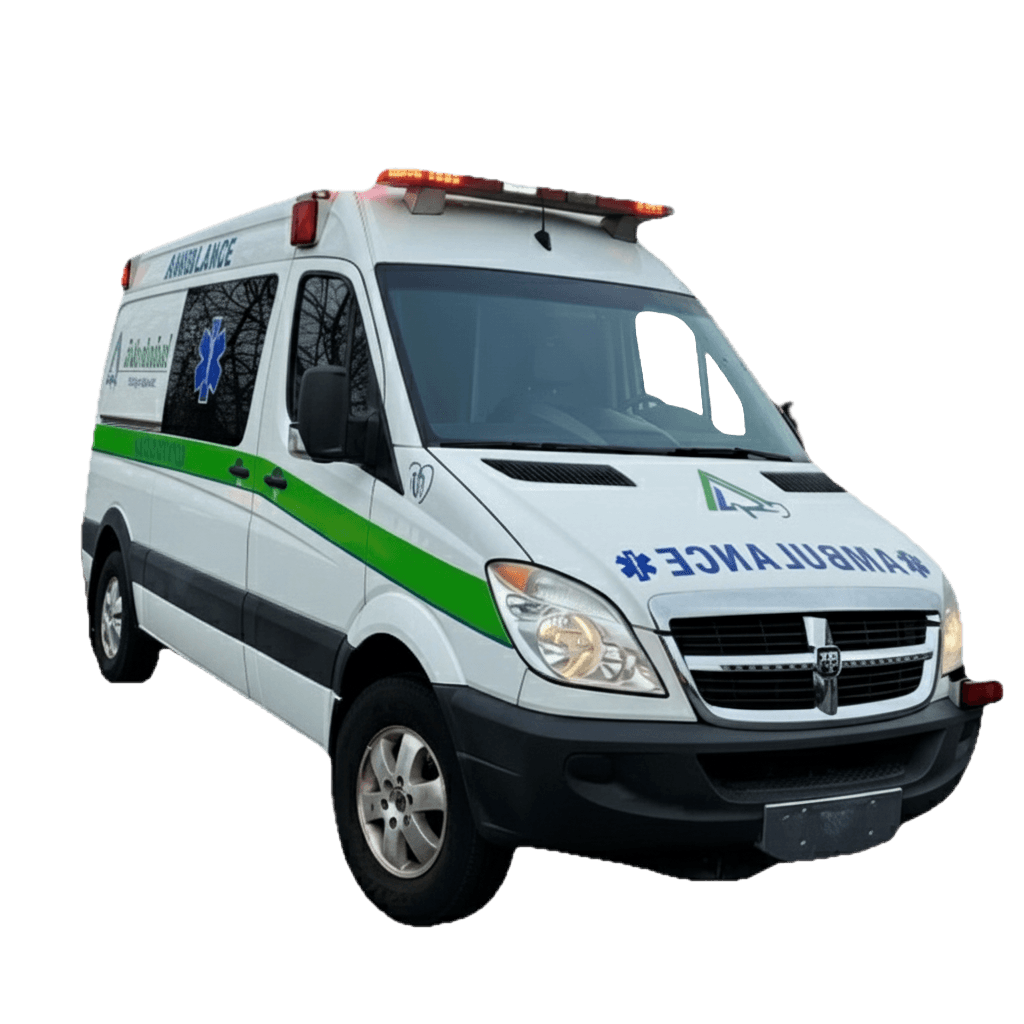
On the New Jersey side, that subcontracted leg is what we do — deliberately, not as an afterthought. Delta Medical Transportation is based in Totowa, about 13 miles from Teterboro Airport, and we are a licensed Basic Life Support (BLS) provider with trained crews, non-emergency stretcher vehicles, wheelchair vans, and oxygen-ready equipment. When a fixed-wing air ambulance lands at TEB with a patient bound for Hackensack University Medical Center, or a family's chartered jet is waiting to fly a parent to be near their children in another state, we are the crew that makes the New Jersey end of that trip work — on time, to the right FBO, with the right equipment for how the patient travels.
To be precise about what we are and aren't: we are a ground provider. We do not operate aircraft, we do not sell flights, and we don't pretend to control what happens on the ramp — that belongs to the FBO and the aircraft operator. What we control is everything on the road: the vehicle, the crew, the timing, the oxygen for the ground portion, and a careful transfer at both ends. That division of labor is exactly how good air-medical trips are supposed to run.
How a Teterboro Patient Handoff Works
An inbound medical flight is a timed sequence, not a taxi pickup. Here is the sequence we run for a patient arriving at TEB.
Coordination call with the flight side
Before anything moves, we get on the phone with whoever is running the flight — the air-ambulance dispatch, the charter broker, or the family's flight coordinator. We confirm the operator, the FBO the aircraft will use (Teterboro's fixed-base operators include Meridian, Signature Flight Support, and Atlantic Aviation), the estimated wheels-down time, how the patient travels (supine on a stretcher or seated), oxygen requirements for the ground leg, and the receiving address — hospital, home, or facility.
Timing to wheels-down, not a guess
Private flights move. Our dispatch tracks the inbound aircraft's ETA and times our departure from Totowa so the vehicle is positioned at the FBO before the aircraft blocks in — early enough to be ready, not so early that a stretcher crew sits for hours. If wheels-down slips, we slip with it.
Meeting at the FBO
General aviation doesn't work like an airline terminal — there is no arrivals curb. Each aircraft taxis to its FBO, and that is where the handoff happens. Our crew checks in with the FBO's front desk, identifies the flight by tail number or operator, and stages the vehicle where the FBO directs.
The transfer, per the flight crew's direction
The medical flight crew knows their patient; the FBO and operator control the ramp. Our crew follows both: the transfer happens where the operator's procedures put it — at the FBO's vehicle area or inside the facility — with the flight crew directing the patient handover and our crew handling the stretcher or wheelchair, the securement, and oxygen changeover to our onboard supply.
The road leg, door to bed
From TEB we take the patient wherever the trip actually ends — Hackensack University Medical Center near the airport, St. Joseph's in Paterson, a home in Bergen or Essex County, or a skilled-nursing facility anywhere in New Jersey. For patients going to a bed rather than a curb, this runs as a bed-to-bed transfer: our crew doesn't leave until the patient is settled.
The Reverse Leg: From an NJ Hospital Bed to an Outbound Flight
Outbound trips are harder than arrivals, because two clocks have to agree: the hospital's discharge and the aircraft's departure slot. A medical flight out of Teterboro is expensive by the hour, and a crew that shows up for the patient after the discharge paperwork stalls — or an hour before the floor is ready — burns money and goodwill on both ends. So we work the timing from both directions. We talk to the discharge planner about when the patient will realistically be ready to move, and to the flight coordinator about the wheels-up window, and we schedule the bedside pickup so the drive to TEB lands the patient at the FBO inside that window — not ninety minutes of waiting on a stretcher in a lobby.
Oxygen continuity is the other thing outbound legs live or die on. A patient leaving a hospital on supplemental oxygen moves from the wall supply to our onboard supply for the drive, and then to the aircraft's supply at the FBO. Before the trip we confirm the liter flow with the sending unit and the flight crew, carry a reserve beyond the expected drive time, and hand off directly to the flight crew so the patient is never between supplies. It's unglamorous logistics — and it's precisely the detail a flight coordinator shouldn't have to hope a subcontractor thought about.
A family member can ride with the patient on our leg of the trip, and on many charter departures they then board the same aircraft — one continuous journey instead of a convoy. Tell us who's traveling when you book and we plan the seating. And if the "outbound flight" is still a question mark — if you're weighing whether to fly at all — our long-distance ground transport covers the East Coast door to door, and for a stable patient it is often the simpler and far less expensive answer.
Morristown (MMU), Newark (EWR), and the Commercial-Stretcher Dead End
Teterboro gets the headlines, but it isn't the only field that matters for medical aviation in New Jersey. Morristown Municipal Airport (MMU) also serves private and fixed-wing medical flights, and for a patient headed to or from Morris County — Morristown Medical Center is close to the field — it can be the more sensible choice. We run the same FBO-coordinated handoff at MMU that we run at TEB, and we cover Newark Liberty (EWR) and Philadelphia (PHL) when an air-medical trip or a commercial flight with airline wheelchair assistance is the plan. For ordinary commercial travel out of EWR — a wheelchair user flying to Florida, an elderly parent arriving at Terminal C — see our Newark Airport medical transport page; that door-to-curb service is its own thing.
Here is the dead end that brings many families to this page: you cannot book a stretcher on a domestic commercial flight.U.S. airlines do not offer stretcher installations on domestic routes, so a patient who must travel lying flat cannot simply be wheeled onto a United flight no matter how the family plans it. That leaves two real options. One is an air ambulance or medevac fixed-wing — someone else's aircraft, with our crews handling the New Jersey ground legs exactly as described above. The other is skipping the aircraft entirely: long-distance ground stretcher transport, door to door, with a crew that stays with the patient the whole way and overnight stops planned on multi-day runs.
Which one is right is a medical and practical judgment, not a sales pitch. Air makes sense when the patient's condition can't tolerate a long road trip or the distance spans half the country; ground wins on cost, simplicity, and door-to-door continuity for most stable patients traveling within a day or two's drive. Call us either way — if the answer is a flight, we'll quote you the ground legs; if the answer is ground, we'll quote the whole trip.
For Flight Coordinators, Brokers & Case Managers
If you coordinate air-medical or charter flights and need a dependable New Jersey ground leg, this is the working relationship we offer: one local number, a dispatch line that answers, and a crew that works to your wheels-down time rather than a rigid pickup slot. Send us the tail number or operator, the FBO, the ETA, and the patient's transfer and oxygen requirements, and we handle the rest — including adjusting to a moved ETA and updating you when the patient is loaded and again when they're delivered.
We're a licensed BLS provider with EMT-trained crews, stretcher and wheelchair vehicles, bariatric-capable equipment, and oxygen-ready vans — based in Totowa, about 13 miles from TEB, with all 21 New Jersey counties as our service area. For repeat work we can set up an account so your dispatchers aren't re-explaining requirements on every trip.
Dispatch line: (973) 389-3110 — or email deltamedicalnj@gmail.com with the trip sheet.
Teterboro & Private Aviation Ground Transport — FAQs
Do you drive onto the tarmac at Teterboro?
Ramp access at Teterboro is controlled by the FBO and the aircraft operator, not by the ground transport company — so we never promise a tarmac transfer we can't guarantee. What we do on every trip is coordinate with the FBO and the flight crew in advance, position at the FBO the operator designates, and complete the patient transfer wherever their procedures call for it — at the FBO's vehicle courtyard, inside the FBO, or closer to the aircraft when the operator arranges escort. The flight crew directs the transfer; our crew executes the ground side of it.
Which airports do you cover for private and air-medical flights?
We cover Teterboro (TEB), the region's primary private-aviation field, and Morristown Municipal (MMU), which also handles fixed-wing medical flights. We also run ground legs for Newark Liberty (EWR) and Philadelphia International (PHL) arrivals, and we can position at smaller New Jersey general-aviation fields when an operator files for one. If the flight lands in or near New Jersey, we can be the ground leg.
How much lead time do you need?
For a scheduled medical flight, booking a few days ahead lets us confirm the FBO, the aircraft's configuration, oxygen needs, and the receiving facility. That said, air-medical trips often come together in 24 to 48 hours. Same-day requests are possible depending on crew availability — call (973) 389-3110 and we'll tell you honestly whether we can cover the window.
What if the flight is delayed?
Delays are normal in private aviation, so the ground leg is coordinated with the flight operator or coordinator and timed to the updated wheels-down time rather than a fixed pickup slot. Call (973) 389-3110 with the tail number and FBO for a free quote.
Do you carry oxygen for the ground leg?
Yes. Our vehicles are oxygen-ready, and for flight handoffs we confirm the patient's flow requirements with the flight crew or coordinator before the trip so there's no gap when the patient moves from the aircraft's supply to ours — and from ours to the receiving facility's. Tell us the liter flow and duration when you book and we'll carry an appropriate reserve.
Who usually books this — the family, the broker, or a case manager?
Any of the three can. Air-ambulance companies and jet charter brokers usually subcontract the ground legs and can book us directly; hospital case managers arranging a discharge to an outbound flight call us to line up the bedside-to-airport leg; and families chartering a flight for a relative often book the ground side themselves once they realize the flight quote ends at the airport. Whoever calls, we work from the same details: tail number or operator, FBO, wheels-down or wheels-up time, and the patient's mobility and oxygen needs.
Are you an air ambulance? Can you arrange the flight itself?
No — Delta Medical Transportation is a ground provider. We do not operate aircraft or sell flights. We are the licensed BLS ground crew on the New Jersey side of a trip that involves an aircraft someone else operates. If you're still choosing between an air-medical flight and driving the whole way, our long-distance ground service covers trips up and down the East Coast and is often the more practical option for a stable patient.
Stretcher or wheelchair at the FBO — which do you send?
Whichever matches the aircraft and the patient. Air-ambulance fixed-wings typically carry the patient supine, so the ground leg is usually a stretcher transfer; a patient flying seated on a family's chartered jet may only need a wheelchair van. We confirm the aircraft's configuration with the flight crew when the trip is booked and send the matching vehicle, crew, and equipment.
Get an Estimate & Request a Ride
Enter your addresses to calculate your estimate
Calculate Your Estimate
Ready to Schedule Your Ride?
Book your appointment today and experience professional, compassionate medical transportation