
Air Ambulance Ground Transport in New Jersey
The New Jersey ground leg of your air-medical mission, both directions: bedside-to-aircraft before wheels-up and aircraft-to-bedside after wheels-down, at TEB, MMU, EWR, and PHL — run by a licensed BLS provider on the flight's timeline, not the other way around. We don't fly. We make sure the part of the mission that happens on the road is as controlled as the part in the air.
Your Fixed-Wing Lands at Teterboro at 14:40. Who's Meeting It?
If you dispatch or coordinate air-medical missions, you already know where the weak point usually is. It isn't the aircraft, the flight crew, or the flight plan — those are yours, and you control them. It's the ground legs at either end, because most air-ambulance operators don't run their own ground fleet in every market. The brochure says "bedside-to-bedside," but in practice the first and last miles get subcontracted to whichever local company answers the phone — and a mission you've planned to the minute now depends on a vendor you've never worked with, in a state you don't operate in, meeting a tail they've never met.
That subcontracted ground leg is the least-controlled segment of the whole mission. A late ground crew burns your flight crew's duty time on an FBO ramp. A wheelchair-van company that shows up without a stretcher can't take the patient at all. A crew that has never done a tarmac handoff doesn't know to wait for the flight medic's report, doesn't carry the paperwork forward, and leaves your receiving facility calling you to ask where the patient's records went.
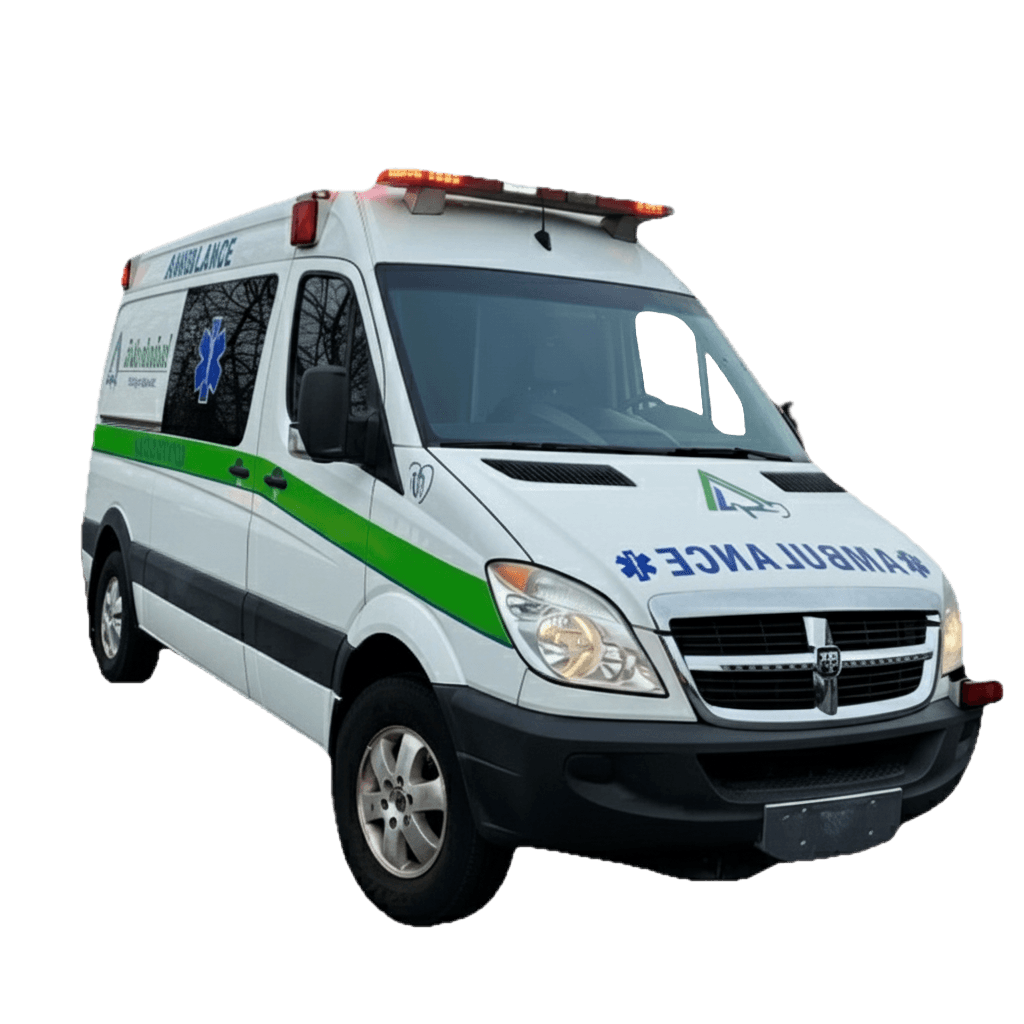
Delta Medical Transportation runs the New Jersey ground legs for these missions. We are a licensed NJ Basic Life Support provider based in Totowa — about 13 miles from Teterboro — running stretcher-equipped, oxygen-ready vehicles with EMT-trained two-person crews, available around the clock. Give dispatch the tail number, the ETA, and the patient report, and the ground leg stops being the part of the mission you worry about. One phone call: (973) 389-3110.
Both Legs of the Mission, Defined
"Ground coordination" means two different jobs depending on the direction. Here is exactly what we run on each.
Leg 1 — Bedside to Aircraft
NJ hospital, home, or facility → FBO / airport
- 1We confirm the tail's ETD, the FBO or ramp location, and the flight crew's requested show time.
- 2Our crew arrives at the bedside early enough to package the patient without rushing — stretcher transfer, securement, oxygen switched to our onboard supply.
- 3We collect the paperwork the flight crew will want: face sheet, med list, and the sending facility's transfer documents.
- 4We stage at the FBO ahead of the requested time and hand off directly to the flight medical crew at the aircraft, with a verbal report and the documents.
- 5The patient stays with our crew until the flight medical crew confirms the handover; if wheels-up slips, dispatch works out the next step with the flight coordinator.
Leg 2 — Aircraft to Bedside
Wheels-down → NJ receiving hospital, rehab, SNF, or home
- 1We track the inbound flight and time our arrival to actual wheels-down, not the original schedule.
- 2Our crew meets the aircraft at the FBO, takes the flight crew's handoff report, and transfers the patient to our stretcher with oxygen continuity.
- 3We carry the transfer paperwork forward so the receiving nurse gets the same information the flight crew had.
- 4We deliver the patient to the receiving facility — to the floor and into the bed, not the lobby — or home, up the stairs if needed, and settled in.
- 5Dispatch confirms completion back to your coordination center so you can close the mission.
For missions using Teterboro specifically — FBO logistics, ramp access, and timing from anywhere in North Jersey — see our dedicated Teterboro private-aviation transport page.
What Your Flight Crew Hands Off To
A tarmac transfer is only as good as the crew receiving the patient. When your flight medic gives the report at the aircraft door, this is what's standing on the other side of it:
Licensed BLS, EMT-trained two-person crews
Delta is a licensed Basic Life Support provider in New Jersey — not a wheelchair-van-only operator. Our crews include EMT-trained staff who take and give a proper verbal handoff report, and who know the difference between a patient report and a pickup address.
Stretcher-equipped, oxygen-ready vehicles
Medical-grade stretchers with securement rated for road transport, and onboard oxygen so continuity is maintained from the aircraft's supply (or the bedside) through the entire ground leg at the ordered flow rate.
Bariatric-capable equipment
Our fleet includes bariatric-rated stretchers and securement. Flag the patient's weight range in the mission details and we assign the right vehicle and staffing the first time — no ramp-side surprises.
Paperwork carried forward
Face sheet, med list, and transfer documents travel with the patient and are handed to the receiving nurse with our crew's report — so the chain of information survives the third handoff of the day, not just the first.
Non-emergency, BLS scope — stated plainly
We transport medically stable patients appropriate for BLS ground transport. We do not provide ALS care, treatment in transit, or critical-care monitoring — if your patient needs that on the ground, we'll say so on the phone, not at the aircraft.
Same crews, same equipment, same standards as our non-emergency stretcher transport service — applied to the one environment where timing is measured against a flight plan.
Researching "Medical Flights" for a Family Member? Read This First
Many people land on this page searching for a medical flight for a parent or spouse — so let's be honest with you before anyone spends money. We do not operate aircraft and we do not sell flights.But we arrange the ground side of these trips every week, and there's one fact most families don't know when they start: no U.S. domestic airline offers stretcher rows.A patient who cannot sit upright for the flight cannot fly on a scheduled domestic airline, full stop. So for a lie-flat patient, a domestic "medical flight" really means one of two things — a chartered air ambulance, or not flying at all.
Commercial airline with a medical escort
Works only for a patient who can sit upright in an airline seat for the whole flight, typically traveling with a medical escort or family member. Airlines provide free wheelchair assistance inside the airport, and oxygen arrangements are possible with advance approval — but the patient must be seated. If sitting for hours isn't realistic, this option is off the table.
Chartered air ambulance
A dedicated medical aircraft with a flight medical crew. Published market figures for domestic air-ambulance flights commonly run $15,000 to $25,000 and up depending on distance and aircraft — those are industry figures, not a quote from us; we don't sell flights. It's the right call when a physician says the patient can't tolerate a long road trip, or the distance is transcontinental and time matters. If you book one, we can run the New Jersey ground legs on both ends.
Long-distance ground transport
For a stable patient, a stretcher-equipped ground vehicle covers the lower 48 at a small fraction of an air ambulance's cost — door to door, with no airport at either end, no tarmac handoffs, and family welcome to ride along. We pace long runs at roughly 500 miles a day with overnight stops on multi-day trips, oxygen continuity planned for the full route.
The pattern we see: families assume flying is faster and therefore better, then discover that between the ground legs, the FBO waits, and the handoffs, a 600-mile air-ambulance mission involves three vehicles and four patient transfers — while a ground trip is one vehicle, one crew, and zero transfers. If your trip can go by ground, start with our long-distance medical transport service, run bed-to-bed so nobody in the family ever lifts the patient. If it genuinely can't, book the air ambulance — and let us make its ground legs the easy part. Either way, call (973) 389-3110 and we'll talk through which one your situation actually calls for.
Airport Coverage & Response
Based in Totowa, we sit inside the triangle formed by the region's three main air-medical gateways — and we schedule around the clock, because medical flights don't keep business hours.
Teterboro Airport
The region's primary private-aviation and fixed-wing medical gateway, about 13 miles east of our Totowa base. We coordinate FBO handoffs with the operator and the flight crew.
Morristown Municipal
Frequent alternate for fixed-wing medical flights into Morris County and western NJ.
Newark Liberty International
Commercial connections and medical escorts arriving on scheduled airlines, plus general-aviation ramp work.
Philadelphia International
South Jersey missions — we run the NJ side of the trip when a flight uses PHL as its gateway.
Pickup and delivery reach every hospital, rehab, skilled-nursing facility, and private home in all 21 New Jersey counties — from the university medical centers in Newark and New Brunswick to a walk-up apartment in Paterson with three flights of stairs. And because the receiving facility isn't always in New Jersey, the same crew that meets your aircraft can continue into New York, Pennsylvania, Connecticut, or beyond as a long-distance continuation — one vendor, one handoff, one invoice for the whole ground side.
For operators and case-management firms, we set up standing accounts: your dispatch contacts and billing terms on file once, then every subsequent mission is a single call with the flight details. The dispatch line is (973) 389-3110 — answered by people who can commit a vehicle, not a call center reading a script.
Air Ambulance Ground Transport — Frequently Asked Questions
Is Delta an air ambulance company?
No — and we don't pretend to be. Delta Medical Transportation is a licensed New Jersey ground provider (Basic Life Support). We do not operate aircraft and we do not sell flights. What we do is run the ground leg of an air-medical mission: bedside-to-aircraft before departure and aircraft-to-bedside after landing, timed to the flight. Air-ambulance operators and hospital case managers can book Delta for the New Jersey ground legs.
Which airports do you cover?
Teterboro (TEB), Morristown Municipal (MMU), and Newark Liberty (EWR) are our core airports — all within easy reach of our Totowa base. We also handle the New Jersey side of missions that use Philadelphia International (PHL) as their gateway, and we can meet aircraft at other regional fields such as Trenton-Mercer or Essex County/Caldwell by arrangement. Tell dispatch the field and the FBO and we'll confirm coverage on the call.
How do you time the ground leg to a flight?
We work backwards from the flight crew's numbers, not the patient's convenience. For a departure, the operator gives us the ETD and the requested patient show time at the FBO, and we schedule the bedside pickup with enough margin for packaging, paperwork, and traffic. For an arrival, we track the tail's actual progress and stage at the FBO for real wheels-down. Your coordination center gets our crew's cell and our dispatch line so everyone is working from the same clock.
What happens if the aircraft is delayed?
Delays are normal in air-medical work and we plan for them. On arrivals, we track the flight and adjust — a crew isn't dispatched to sit for hours against a stale ETA. On departures, if wheels-up slips after the patient is packaged, whether the crew waits on site depends on the trip — dispatch settles that with the flight coordinator, and the patient is never left alone on a ramp or in an FBO lobby. Price depends on distance, level of care, and equipment. Call (973) 389-3110 for a free quote.
Can you take the patient across state lines after landing?
Yes. If the receiving facility is in New York, Pennsylvania, Connecticut, or beyond, the same crew that meets the aircraft can complete the trip — that's our long-distance medical transport service working as the back half of your mission. One handoff at the aircraft, one vehicle to the destination bed, no second ground vendor to coordinate.
How does an operator or case-management firm set up a standing account?
Call (973) 389-3110 and ask for a facility or operator account. We'll take your dispatch contacts, billing arrangement, and documentation requirements once, so that each mission afterward is a single call or email with the flight details. International assistance companies can arrange the New Jersey ground legs with us the same way — you get a direct line, not a web form.
Is oxygen maintained during the ground leg?
Yes. Our vehicles are oxygen-ready and our crews maintain continuity from the bedside or the aircraft's supply onto ours, at the ordered flow rate, for the entire ground leg. Tell dispatch the patient's oxygen requirement when you book so we confirm adequate supply for the route plus a safety buffer.
What level of patient can your crews accept?
Medically stable patients appropriate for Basic Life Support ground transport — stretcher-bound, wheelchair, oxygen-dependent, and bariatric patients included. We are a non-emergency BLS provider: we don't provide ALS interventions or treatment in transit, and a patient who needs critical-care monitoring on the ground leg needs a different resource. When you give us the patient report, we'll tell you straight whether the patient is a BLS-appropriate handoff.
Get an Estimate & Request a Ride
Enter your addresses to calculate your estimate
Calculate Your Estimate
Ready to Schedule Your Ride?
Book your appointment today and experience professional, compassionate medical transportation