
Transportation to RWJ University Hospital in New Brunswick
Non-emergency wheelchair and stretcher transportation to and from Robert Wood Johnson University Hospital — discharges home, recurring treatment at Rutgers Cancer Institute, pediatric specialty visits, and transfers in from community hospitals across Central New Jersey.
Why So Many of Our Trips End at This One Campus
Robert Wood Johnson University Hospital is not a neighborhood hospital, and the trips people book to reach it are not neighborhood trips. As the flagship academic medical center of RWJBarnabas Health and the principal teaching hospital of Rutgers Robert Wood Johnson Medical School, RWJ New Brunswick is where Central New Jersey patients are sent when their local hospital cannot offer the specialty they need — advanced cancer care, complex cardiac surgery, transplant programs, high-acuity pediatrics. That means the typical passenger heading there is not someone from around the corner. It is a patient from Edison, Old Bridge, or Somerset County whose cardiologist referred them to a New Brunswick specialist, or an oncology patient making the same treatment run three times a week.
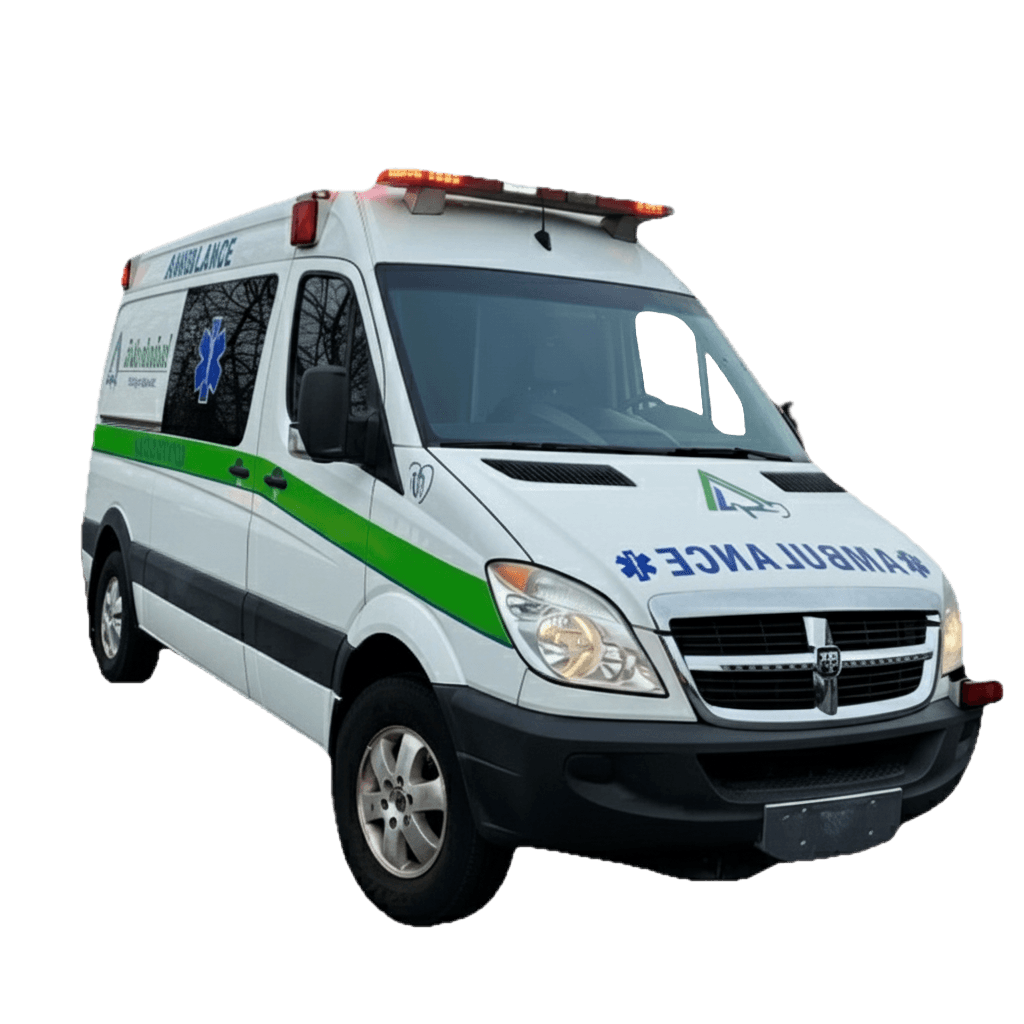
Delta Medical Transportation handles exactly that kind of trip. We are an independent, licensed non-emergency transport company — not affiliated with the hospital — providing scheduled, ground-level transportation for medically stable patients: wheelchair vans for patients who can sit upright, and stretcher vehicles with two-person, EMT-trained crews for patients who must travel lying flat. Everything is pre-booked and non-emergency. If someone is in a medical crisis, that is a 911 call, not a reservation.
This page covers how transport to and from the New Brunswick campus actually works: who books these rides, how discharge-day timing is coordinated, and what recurring treatment transport looks like for the programs RWJ is known for.
Who Books Medical Transport to RWJ New Brunswick
Four kinds of trips make up most of the traffic to and from this campus.
Discharges Home Across Central NJ
Because RWJ draws admissions from such a wide radius, its discharges scatter just as widely — a patient going home after cardiac surgery may live forty minutes away in Monmouth County. Families and case managers book us for the ride home, to a rehab facility, or to a skilled-nursing placement, with wheelchair or stretcher options depending on how the patient leaves the building.
Recurring Oncology Trips to Rutgers Cancer Institute
Rutgers Cancer Institute of New Jersey — the state's NCI-designated comprehensive cancer center, alongside the RWJ campus — generates some of the most demanding transport schedules we see: chemotherapy infusions, daily radiation courses, and clinical-trial visits that repeat for weeks or months. We set these up as standing, recurring rides.
Pediatric Specialty Visits
The New Brunswick campus is a pediatric destination too, with the Bristol Myers Squibb Children's Hospital at RWJ and a Children's Specialized Hospital location nearby. We transport medically stable children to appointments, therapy programs, and discharges — always with a parent or guardian riding along.
Transfers In From Community Hospitals
When a community hospital refers a stable patient to New Brunswick for specialty consultation, testing, or a scheduled procedure, someone has to move them. We handle scheduled, non-emergency transfers from hospitals, SNFs, and rehab centers around Central New Jersey, coordinating timing with staff at both ends.
Oncology Transport: Built Around Infusion Days
Cancer treatment transport has a rhythm unlike any other trip we run, and it is worth spelling out, because it is the single biggest reason patients call us about New Brunswick. An infusion appointment is not a fixed-length event. A session scheduled for two hours can stretch to five depending on labs, pre-medications, and how the patient tolerates treatment. A daily radiation course is the opposite — short visits, but every weekday for weeks. Neither pattern works with a ride service that needs an exact pickup time booked days in advance.
So we structure these trips differently. The morning leg runs on schedule, timed to the appointment. The return leg stays open: when treatment ends, the patient or a family member calls dispatch and we send the vehicle. For radiation courses and other repeating schedules, we set up a standing arrangement once — same pickup time, same days — so nobody is re-booking transportation every night. Patients who are steady on their feet at the start of a treatment cycle often are not by the end of it, so a wheelchair van can be swapped in at any point without redoing the whole arrangement.
One honest boundary: our crews drive, assist with boarding, and secure the patient — they do not provide medical care during the ride. A patient who needs clinical monitoring in transit needs more than a BLS non-emergency vehicle, and if that is the situation, we will say so when you call rather than book a trip that is wrong for the patient.
Pediatric Trips: A Parent in the Vehicle, Every Time
Families traveling to the children's facilities on and near the New Brunswick campus ask two questions before anything else: can I ride with my child, and is the vehicle set up for them? The answers are yes and yes. A parent or guardian rides along on every pediatric trip — we would not run one otherwise — and securement is matched to the child, whether that means a wheelchair locked into a lift-equipped van or an appropriate seating arrangement for a smaller passenger. Tell us the child's age, size, and how they travel when you book.
The trips themselves tend to be therapy-heavy: children in rehabilitation programs often attend multiple sessions per week, sometimes across several disciplines, and parents who are also juggling work and other kids need those rides to be automatic. Recurring scheduling handles that — one call sets the pattern, and the same routine repeats each week.
Scope, stated plainly: we transport medically stable children. We are not a pediatric critical-care or specialty ambulance service, and a child who requires medical intervention or monitoring en route needs a level of transport we do not provide. Hospital staff can tell you which level your child needs; if you describe the situation to us, we will tell you honestly whether we are the right fit.
Discharge Day at a Major Academic Center
Discharges from a hospital this size rarely run on the clock. The attending rounds late, a final test result holds things up, pharmacy takes another hour with the take-home medications — and a transport company that booked a rigid pickup window either leaves the patient stranded in the lobby or charges for the wait. Our approach, the same one described on our hospital discharge transport page, is built for that reality: call us as soon as a discharge is anticipated, even before the exact hour is confirmed. We reserve the vehicle and crew, keep a phone line open with the family or the case manager, and shift the pickup time as the real discharge time firms up. Same-day requests are workable too — planned discharges get same-day availability whenever we can provide it.
The vehicle decision matters most on discharge day. A patient leaving after a routine stay usually rides seated in a wheelchair van. A patient leaving after major surgery — cardiac procedures being the classic New Brunswick example — may need to travel lying flat, which means a stretcher vehicle with a trained two-person crew, oxygen-ready if the patient goes home with supplemental oxygen, and bariatric-capable equipment when needed. Describe the patient's condition when you call and we will match the vehicle — including telling you when the less expensive option is the right one.
For case managers and social workers who arrange these trips repeatedly: we work with discharge teams across New Jersey, and a single call to (973) 389-3110 is all it takes to establish an account so booking future patients is faster.
Where We Pick Up: The Towns That Feed RWJ New Brunswick
An academic referral center pulls patients from a wide map, and our pickup radius matches it. The heaviest traffic comes from Middlesex County itself — starting with New Brunswick and its immediate neighbors, then Edison, Piscataway, Woodbridge, Perth Amboy, Old Bridge, and Sayreville. Beyond the county line, we regularly bring patients in from Somerset, Union, and Monmouth County towns whose local hospitals refer specialty cases to New Brunswick.
Two practical notes for anyone booking a longer inbound trip. First, the New Brunswick medical corridor is a dense, multi-building campus shared with Rutgers facilities — confirm with your appointment coordinator exactly which building and entrance you need, and give us that detail when you book, because the right drop-off point saves a frail patient a long walk. Second, build the travel time into timed appointments like infusion slots; we schedule pickups so the ride, not the patient, absorbs the traffic. RWJ New Brunswick is also one campus within the far larger Rutgers Health network — our guide to transportation across the Rutgers Health system covers the other locations patients are commonly referred between.
What a Trip to RWJ New Brunswick Costs
Pricing is trip-specific, not flat-rate, because the trips genuinely differ. The main factors: distance from your pickup address to the campus, wheelchair van versus stretcher crew, wait-and-return versus two separate legs, stairs or a difficult transfer at the home, time of day, and whether it is a one-time ride or a recurring schedule. As a rough market orientation, local wheelchair-van legs around New Jersey tend to run modest double-digit to low triple-digit amounts while stretcher trips run meaningfully higher — typical market figures, not Delta's rate card. We quote your actual trip, all-in, before you commit.
Call with your pickup address and appointment details and we will price the trip in a few minutes — free, with no obligation.
Call (973) 389-3110 for a Free QuoteRWJ New Brunswick Transport — Frequently Asked Questions
Do you provide transportation to Rutgers Cancer Institute of New Jersey?
Yes. Many of our recurring New Brunswick trips are oncology patients traveling to Rutgers Cancer Institute of New Jersey, which sits alongside the RWJ campus. We schedule around infusion and radiation calendars, and because infusion days can run long and finish at unpredictable times, we build in flexible return pickups — the patient or a family member calls when treatment wraps up and we dispatch the return leg. Wheelchair vans are available for patients too fatigued to walk far after treatment.
Can you handle a same-day discharge from RWJ University Hospital?
Usually, yes. We keep same-day availability for planned discharges and we know discharge times slip — a doctor signs off late, paperwork takes longer, pharmacy holds things up. The best approach is to call us as soon as a discharge date is anticipated, even before the hour is confirmed. We reserve the vehicle, stay in touch with the family or the floor by phone, and adjust the pickup time as the real discharge time firms up.
Can a parent ride along on a child's trip to Children's Specialized Hospital or the children's hospital at RWJ?
Yes — for pediatric trips we expect a parent or guardian to ride along, and there is room in the vehicle for them. To be clear about scope: we transport medically stable children to scheduled appointments, therapy programs, and discharges. We are a non-emergency BLS provider, so a child who needs active medical care during the ride needs a higher level of transport than we provide, and we will tell you that honestly when you call.
Do I need a wheelchair van or a stretcher vehicle for an RWJ trip?
It depends on how the patient travels. If they can sit upright — in their own wheelchair or one of ours — a wheelchair van is the right fit and the more economical option. If the patient must lie flat, is recovering from major surgery, or is too weak to sit up for the ride, we send a stretcher vehicle with a two-person, EMT-trained crew. If you are not sure, describe the patient's condition when you call and we will recommend the appropriate level — even when the answer is the cheaper vehicle.
We live outside New Brunswick — how far will you come to bring us to RWJ?
Patients travel to RWJ New Brunswick from all over Central New Jersey, and so do we. We regularly pick up in Edison, Piscataway, Woodbridge, Old Bridge, Perth Amboy, Sayreville, and across Middlesex County, as well as from neighboring Somerset, Union, and Monmouth County towns. Longer pickups just need to be scheduled with the travel time in mind, especially for timed appointments like infusion slots.
How much does a medical transport trip to RWJ New Brunswick cost?
There is no flat rate, because trips vary. Price depends on the distance from your pickup address, whether the patient needs a wheelchair van or a stretcher crew, wait-and-return versus two one-way legs, stairs or a difficult transfer at home, and time of day. Around the industry, local wheelchair-van trips tend to run modest double-digit to low triple-digit figures per leg while stretcher trips run meaningfully higher — those are typical market figures, not Delta's rate card. Call (973) 389-3110 with your addresses and we will quote your actual trip in minutes, free.
Are you affiliated with RWJ University Hospital or RWJBarnabas Health?
No. Delta Medical Transportation is an independent, licensed non-emergency transport company. We are not part of, endorsed by, or contracted through the hospital — we simply transport patients to and from it, the way we do for hospitals across New Jersey. Facilities and case managers who want to arrange transport for patients regularly can call us to establish an account.
Is this an emergency ambulance service?
No. Everything on this page is scheduled, non-emergency ground transportation for medically stable patients. If someone is experiencing a medical emergency, call 911 — do not book non-emergency transport.
Get an Estimate & Request a Ride
Enter your addresses to calculate your estimate
Calculate Your Estimate
Ready to Schedule Your Ride?
Book your appointment today and experience professional, compassionate medical transportation