
Transportation to Morristown Medical Center
Scheduled, non-emergency rides to and from Morristown Medical Center — cardiac surgery discharges, weeks of recurring cardiac rehab trips, and facility transfers — by wheelchair van or stretcher, with trained two-person crews serving Morris, Sussex, and Warren counties.
Getting To — and Home From — Morristown Medical Center
Morristown Medical Center, Atlantic Health System's flagship hospital in Morristown, is consistently ranked among New Jersey's top hospitals, and its Gagnon Cardiovascular Institute runs one of the highest-volume cardiac programs in the region. That reputation pulls patients in from far beyond Morristown itself: people travel from across Morris County and from the more rural stretches of Sussex and Warren counties for heart surgery, cardiac procedures, and specialty care they cannot get closer to home.
The catch is that the same distance that makes the hospital worth traveling to makes getting there — and getting home — a real logistics problem. A patient recovering from open-heart surgery cannot fold themselves into the passenger seat of a sedan. A cardiac rehab program that meets several times a week for weeks on end is a lot to ask of an adult child who lives an hour away and works full time. Delta Medical Transportation exists for exactly these trips: scheduled, non-emergency ground transportation to and from Morristown Medical Center, by wheelchair van or stretcher, with trained, EMT-level two-person crews and oxygen-ready vehicles.
To be clear about what we are and are not: we are an independent, licensed New Jersey medical transportation company — not part of Atlantic Health System, and not an emergency service. We handle the planned trips: the discharge home after a cardiac stay, the standing Tuesday-and-Thursday rehab rides, the transfer in from a community hospital for a scheduled procedure. If someone is experiencing a medical emergency, call 911.
Cardiac Surgery Discharges: Why the Family Car Usually Won't Work
Because the Gagnon Cardiovascular Institute performs so much cardiac surgery, a large share of the calls we get about Morristown Medical Center are discharge rides after bypass surgery, valve repair or replacement, or other open-heart procedures. These discharges have a constraint that surprises many families: sternal precautions. After the breastbone has been opened and wired back together, patients are typically told not to push, pull, or lift more than a few pounds with their arms, not to twist their torso, and not to let anyone tug on their arms during a transfer — usually for six to eight weeks while the bone heals.
Now picture what getting into a typical car actually requires: gripping the door frame, bracing an arm against the seat, twisting the torso to swing the legs in, pulling the heavy door shut. Every one of those motions violates the precautions. Add a fresh chest incision that a shoulder seatbelt presses directly against, and it becomes clear why care teams so often tell families that a private car is not the right way home from heart surgery.
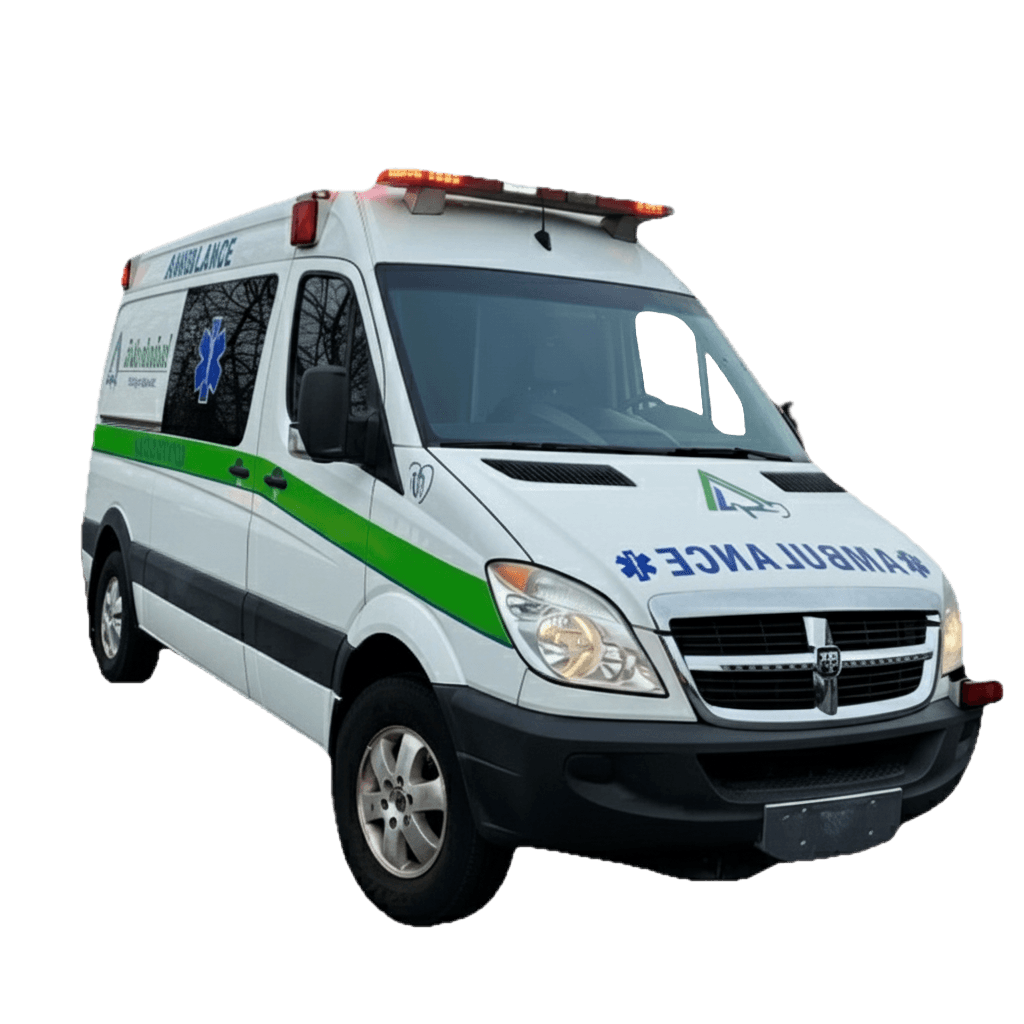
We solve this two ways, depending on what the care team recommends. Patients who need to stay reclined — or who simply should not attempt a vehicle transfer at all — ride on a medical stretcher in one of our BLS-equipped vehicles: the crew brings the stretcher to the patient, performs the transfer themselves without pulling on the patient's arms, and secures them for a flat or gently inclined ride. Patients cleared to sit upright ride in a wheelchair van — they stay in the wheelchair the entire time, rolled up a ramp or lift and secured in place, so there is no climbing in or out of anything. Either way, a trained two-person crew does all of the physical work, our vehicles are oxygen-ready for patients discharged on supplemental oxygen, and we carry bariatric-rated equipment when it is needed.
The same logic applies to other major procedures at the hospital — orthopedic and spine patients under lifting or twisting restrictions, and frail patients after long stays, face the same car-transfer problem and use the same solutions.
Cardiac Rehab Transportation: The Rides That Come After the Ride Home
The discharge is one trip. Cardiac rehabilitation is dozens. Outpatient cardiac rehab programs commonly run two to three supervised sessions per week for around twelve weeks — often 36 sessions in total — and the evidence is blunt: patients who complete the program do meaningfully better than patients who drift out of it. One of the most common reasons people drift out is not motivation. It is the driving.
Think about what the schedule demands from a family in Sparta, Hackettstown, or Newton: two or three round trips a week, each one potentially an hour or more of driving each way, for three months, usually during working hours. A spouse who no longer drives cannot do it. An adult child with a job cannot keep doing it. This is precisely the kind of problem recurring medical transportation is built for.
We set cardiac rehab rides up as a standing schedule: you give us the program days and times once, and the rides recur automatically — same pickup routine, a driver who comes to the door, and a return trip after the session. There is no re-booking every week and no wondering whether Thursday's ride is confirmed. If the program adjusts the schedule, one phone call adjusts the rides. Most rehab patients ride in our wheelchair vans or as ambulatory passengers with door-through-door assistance; patients who still need more support can ride at stretcher level.
The same standing-schedule model covers other recurring treatment at the hospital and its outpatient facilities — recurring cardiology follow-ups, wound care series, oncology treatment schedules, and pre- and post-surgical appointment runs. If it repeats, we can make it automatic.
Wheelchair Van or Stretcher: Which Does a Cardiac Patient Need?
This is the question families ask us most often when booking a ride from Morristown Medical Center, and the honest answer is: follow the care team's guidance first, then let us match the vehicle to it. As a rule of thumb, the deciding factor is not how sick the patient is — it is whether they can safely sit upright for the whole ride and tolerate a transfer into a seated position without using their arms.
A patient a few days out from a catheter-based procedure who is walking the halls will usually do fine in a wheelchair van with door-through-door assistance. A patient leaving after open-heart surgery may also be cleared to sit — many are — but the transfer has to be done for them, slowly, with the crew supporting the movement so the patient never braces or pulls. A patient who is deconditioned after a long stay, on continuous oxygen, or simply not safe upright for a forty-five-minute ride back to Warren County belongs on a stretcher, full stop. When you call, tell us the procedure, what the discharge paperwork says about activity restrictions, and how far the ride is; we will tell you honestly which level fits — including when the cheaper option is the right one.
Whatever the level, the crew standard is the same: licensed BLS operation, trained two-person crews on stretcher trips, oxygen-ready vehicles, and equipment rated for bariatric patients when needed. And one practical note that matters more for cardiac patients than most: our drivers are trained to drive like the cargo is fragile, because it is. A fresh sternotomy feels every pothole — smooth, unhurried driving is part of the service, not a courtesy.
Where We Pick Up: Morris, Sussex, and Warren Counties
Morristown Medical Center draws from a catchment that is suburban at its core and genuinely rural at its edges — and the further out a patient lives, the more the transportation math breaks down for families. These are the areas we serve most often for this hospital:
Morris County
The hospital's home county and the bulk of our trips — Morristown itself, plus Parsippany, Denville, Dover, Madison, Rockaway, and the rest of the county. Even a fifteen-minute trip matters when the patient is under sternal precautions and cannot use a car. See our Morris County service page for full town coverage.
Sussex County
From Newton, Sparta, Hopatcong, and the surrounding towns, the drive to Morristown can easily run an hour each way — the classic case where a retired spouse cannot make the trip and a working family cannot make it three times a week. Our Sussex County transportation covers one-time discharges and standing rehab schedules alike.
Warren County
Patients from Hackettstown, Washington, and Phillipsburg regularly travel to Morristown for cardiac care they cannot get locally. We run both directions — into the hospital for procedures and appointments, and back out for discharges — across all of Warren County.
We are based in Totowa and serve all 21 New Jersey counties, so trips connecting Morristown Medical Center with Passaic, Essex, Bergen, or any other county are routine as well.
How Discharge-Day Coordination Works
Discharge timing at any major hospital is unpredictable — the physician sign-off, final nursing assessments, pharmacy, and paperwork all have to line up, and the target time moves. Our process is built around that reality, and it matches how we work with discharge planners and case managers at hospitals across New Jersey:
Call as soon as discharge is anticipated
You do not need a confirmed time — a likely day is enough. We reserve a vehicle and crew, and note the patient's mobility level, oxygen needs, stairs at home, and destination.
We coordinate directly with the floor
With your permission, we stay in contact with the discharge planner, case manager, or the family member on-site, and adjust the pickup time as the order and paperwork come together — so the patient is not sitting in a lobby waiting for a ride that was booked for the wrong hour.
The crew comes to the patient
On arrival, our crew meets the patient at the unit, handles the transfer to the wheelchair or stretcher themselves, and manages everything through to the front door — or, for stretcher patients, all the way to the bed at home or at the receiving facility.
Same-day availability for planned discharges
When a discharge comes together faster than expected, call us — we maintain same-day availability for planned discharges and mobilize quickly when a patient is cleared to leave.
Discharges are not the only direction. We also bring patients into Morristown Medical Center — transfers from community hospitals and skilled-nursing facilities for scheduled cardiac procedures and specialty consultations, and rides from home for pre-surgical testing and admissions. Facilities that send patients this way regularly can call us at (973) 389-3110 to establish an account, which keeps repeat bookings to a short phone call. Read more about the full process on our hospital discharge transport page.
What a Trip to Morristown Medical Center Costs
There is no flat rate, because no two trips are the same. The price depends on the level of service — a wheelchair van costs less than a stretcher crew — plus total mileage (a Morristown pickup and a Newton pickup are very different trips), whether oxygen or bariatric equipment is needed, stairs at the home, wait-and-return versus one-way, and time of day. Standing cardiac rehab schedules are priced as recurring service rather than as a stack of one-off trips.
As a market reference point, non-emergency wheelchair trips in New Jersey often run in the low-to-mid hundreds of dollars and stretcher trips meaningfully more — but those are typical market figures, not Delta's rate card. Call with your pickup and drop-off addresses and we will quote your actual trip in a few minutes, free, with one all-in number and no surprise add-ons.
Call (973) 389-3110 for a Free QuoteMorristown Medical Center Transport — Frequently Asked Questions
Is this emergency transport to Morristown Medical Center?
No. Delta Medical Transportation provides scheduled, non-emergency ground transportation to and from Morristown Medical Center — discharges, appointments, cardiac rehab sessions, and facility transfers. If someone is having chest pain, trouble breathing, or any other medical emergency, call 911 immediately; do not book a scheduled ride.
Can you transport a patient home after open-heart surgery?
Yes. This is one of the most common trips we run from Morristown Medical Center. Patients discharged after bypass or valve surgery are usually under sternal precautions — no pulling, pushing, or lifting with the arms — which rules out climbing into a family car. We provide stretcher transport for patients who need to stay reclined and careful wheelchair transport for those cleared to sit, with a trained two-person crew doing all of the lifting and transferring.
Do you handle recurring cardiac rehab transportation?
Yes. Outpatient cardiac rehab typically runs multiple sessions a week for several weeks or months, and missing sessions undermines the program. We set up standing, recurring rides on the patient's rehab schedule so the same trip does not have to be re-arranged every time. Tell us the weekly schedule when you call and we build the rides around it.
Which towns and counties do you pick up from?
We regularly carry patients between Morristown Medical Center and homes across Morris County — Morristown itself, Parsippany, Denville, Dover, Madison, Rockaway, and surrounding towns — as well as Sussex County (Newton, Sparta, Hopatcong) and Warren County (Hackettstown, Washington, Phillipsburg). We serve all 21 New Jersey counties, so if your town is not listed, call us anyway.
How does a discharge-day pickup from the hospital work?
Call us as soon as a discharge date is anticipated, even before the exact time is confirmed. We reserve a vehicle and crew, then stay in contact and adjust the pickup time as the discharge order, final assessments, and paperwork come together. When the patient is ready, our crew meets them at the unit, handles the transfer to the vehicle, and takes them to the door of their home or next facility — no waiting in the lobby.
How much does transport to or from Morristown Medical Center cost?
It depends on the level of service (wheelchair van versus stretcher), total mileage, whether oxygen is needed, stairs at the home, and time of day. Recurring cardiac rehab rides are priced differently than a one-time discharge. Call (973) 389-3110 with the pickup and drop-off addresses and we will give you one transparent, all-in quote in a few minutes, free.
Are you affiliated with Morristown Medical Center or Atlantic Health System?
No. Delta Medical Transportation is an independent, licensed medical transportation company. We are not affiliated with, endorsed by, or operated by Morristown Medical Center or Atlantic Health System — we simply transport patients to and from the hospital, and we coordinate timing with its discharge planners and case managers the same way we do at hospitals across New Jersey.
Can a family member ride along?
In most cases, yes — one family member or caregiver can usually accompany the patient at no extra charge, which many families appreciate on a discharge day or a long ride back to Sussex or Warren County. Mention it when you book so we confirm seating for your specific vehicle and trip.
Get an Estimate & Request a Ride
Enter your addresses to calculate your estimate
Calculate Your Estimate
Ready to Schedule Your Ride?
Book your appointment today and experience professional, compassionate medical transportation